Sunday, December 21, 2008

When Does Ministry Work?

Ministry is more effective when…
  • We realize it has little to do with advertising or promotions.
  • We focus less on what we say and more on how we act.
  • Every interaction reflects the values we embrace.(Think personal, biblical, excellent, relevant, simple, etc.)
  • We realize that louder isn’t better.
  • Someone says “I’m in” and timely follow-up happens.
  • We look at it as relationship building and stop viewing it as information sharing.
  • We talk less about how great we are (”organization-focused”) and instead deliver a message and ministry that leads to life change (”people-focused”).
  • We realize we can’t force what we think people need until they know they need it.
  • We reduce the number of competing messages we are trying to communicate.
  • We know who we are trying to reach.
  • We’ve acknowledged we can’t reach everyone.
  • We’ve developed a way to measure the outcomes of our efforts.
  • We deliver on what we promise.
Based on a blog from Tony Morgan.

Tuesday, December 9, 2008

Kissing Toilets


Perry Noble, Senior Pastor of NewSpring Church, located in South Carolina shared this story on Friday night at their worship celebration…

I was in the bathroom the other day taking a “pee pee” when I turned to my right and there was Charisse (my little daughter) staring at me. (It was totally awkard!)

SO…I told her, “Daddy is pee pee’ing in the toliet…you will do that one day.”

She looked at me, smiled and said, “pee pee!!!”

I then turned around to wash my hands, explaining to her that after we pee pee we clean our hands…but when I turned and looked at her she was staring at the toilet.

I was afraid she was going to stick her hands in it…so I told her, “don’t touch.”

BUT…that’s when she did the unthinkable…she leaned forward and kissed the toilet lid!

I wanted to throw up! Seriously…WOW! I told her, “NO!!!” And I scooped her up…and THAT IS WHEN SHE WANTED TO KISS ME!!!

AHHHHHH! What is a dad to do? I LOVE my little girl…but she kissed a freakin’ toilet seat!!! I watched the whole thing…it was SO GROSS…

I was about to put her down when the Lord spoke to my heart and said, “Hey Perry…what you just saw her do…you’ve done many times. You’ve kissed the “toilet” of the world all week long and then came into church and tried to kiss me!”

BAM!

For WAY TOO LONG coming to church was about making me feel better and not exalting a HOLY and RIGHTEOUS GOD. I would “kiss toliets” all week long by the way I spoke about other people, the things I looked at…the places I allowed my mind to wander…and then I would come to church wanting God to make me feel better…BUT COMPLETELY unwilling to repent of the sin that was dominating me.

One of the things that I think we often forget as follower of Christ is that He knows…He knows our hearts…He knows our minds…and He knows the toliets we kiss all week long.

Judas kissed Him…but it was a kissed laced with betrayal and greed. God is not pleased with our church attendance…but rather our repentance.

Just wondering…kissing any toilets? Anything in your life that you know God doesn’t approve of…you refuse to repent…and you are going to come to church this Sunday and pretend that eveything is okay with you & God?

These are tough questions to wrestle with…but doing so will reveal our hearts!!!

One more thing…I LOVE MY LITTLE GIRL! Even watching her kiss a toilet make me stop loving her. It made me sick…but didn’t change the fact that I love her. I don’t love her because of what she does…I love her because she’s mine!!!

I am so glad that God treats us the same way…even through the time when I was kissing toliets and breaking His heart…He never stopped loving me…and it was His patience and kindness that drew me to Him (and still does) and conforms me more and more to who He has called me to be!!!

Gotta go give Charisse a kiss!!!

Thursday, October 23, 2008

Flying SOLO


This innovative devotional Bible based on The Message//REMIX is designed to change how students and youth leaders interact with God's Word and revolves around lectio divina, or “divine reading.”

This is what Joe Romero uses. You can pick up a copy at CAFE de FE.

Thursday, October 16, 2008

Comedy Nite 08

Tuesday, October 14, 2008

5 Dangers of Always Being On


Here’s a few recent thoughts about the dangers of always “being on” in youth ministry:

You’re only in problem-solving mode
You’re so busy solving other people’s problems you don’t think about your own issues. When the pace of life increases, we tend to focus on helping others, and not ourselves. Every message is applied to someone else’s situation, every learning is to be taught to another audience. One of the dangers of always being on is that until you turn it off you won’t look deeply into your own life. I wonder sometimes if busyness and others-focused-to-a-fault is to protect the real me from coming to the surface.

You sacrifice those that matter most
Always being on robs from those you would be with if you were off. And while taking your son with you to an event is one thing … calling summer camp with your wife vacation is not. When you are always on as a pastor, you justify the need to do ministry and know those that love you the most will show you the most grace.

You hold the ministry too tightly
If you’re always working, there’s nothing left to lead and no decisions to be made. When you’re gone or off, other people have to step up. Loosening the grip of leadership and control allows others to take responsibility. Ironically, the very thing you would say you need to help turn things off only happens when you let go.

You begin to take shortcuts
In an effort to slow down the pace or at least pace yourself for the rest of the youth ministry “on” marathon - you’ve only got two options - well, 3, if you count death as one. 1) you can simply run faster. Dig deeper, work later and try harder and get it all done. Or, 2) you can take shortcuts. It starts with the small things to help you save time, but eventually spirals into spiritual and character issues. When you run hard and don’t stop, at some point you’ve got to try and stop the pain so you cut through no man’s land and hope you don’t get caught.

You will eventually leave youth ministry
Here’s the endgame - if you don’t quit every once in a while, you will eventually quit altogether. Youth ministry can be a tireless machine of good in the life of students. It can be a tireless machine that chews up good youth workers, too. I’ve been doing youth ministry long enough to see so many leave this calling/profession. There’s a lot of good reasons to quit, you being irresponsible with your time and always being on is certainly not one of them.

Take some time OFF and get a break from always being ON. You’ll be better off for it, I promise.

Taken from Josh at www.MoreThanDodgeball.com

Thursday, October 2, 2008

52 Links Youth Workers Should Check Out


Joshua Griffin, the High School Pastor at Saddleback Church, just posted this list on www.MorethanDodgeball.com.
check it out here.

Thursday, September 25, 2008

Essential Church?

The publisher is offering you a free electronic copy of Tom Rainer's (author of Simple Church) latest book, essential church? (you just give them your email address which gives them permission to subscribe you to their newsletter, and then you download the book - that seems to me a fair exchange)

The book addresses the question, "Why do so many young adults (18 to 22) leave the church, and what will it take to bring them back?"

The book is based on a study of one-thousand so-called "church dropouts" who were interviewed about why they left. Their answers are quite surprising, having less to do with "losing their religion" and more about the desire for a community that isn't made stale by simply maintaining the status quo.

In turn, the Rainers offer churches four concrete solutions toward making their worship community an essential part these young people's lives again:

Simplify - develop a clear structure and process for making disciples.

Deepen - provide strong biblical teaching and preaching.

Expect - let members know the need for commitment to the congregation.

Multiply - emphasize evangelism, outward focus, and starting new churches.

Click HERE to get your FREE book!

Taken from www.ministrybestpractices.com

Thursday, September 18, 2008

3 Ways to Get Chips in Your Pocket

Just starting out in youth ministry? In some ways, we’re always going back to basics and the fundamentals of youth ministry. Here’s 3 ways to get some chips in your youth ministry credibility bank right from the start - if you ever have to push “all in” these will have come in handy:

Communicate … no, over-communicate
I’m confident that no parent in church history has ever said to a youth worker, “I just wish our youth ministry would communicate less with our family.” Instead, I’m always wondering if we communicate enough and effectively. Are we really expecting that a promo flyer handed to a student will make it home? When was your website last updated? Have we clearly articulated the vision for the change, or are we expecting word to just somehow get out? List all of the ways you’re communicating - then ask, is my message really getting out?

Show up during a crisis
Youth ministry shines when pastors and volunteers step in during a crisis. The opposite is almost always true - youth ministry takes a huge hit when someone’s urgency doesn’t elicit a matching urgent response. It only takes a few days of “not getting to it” before irreparable trust damage is done. A huge win for your youth ministry future is knowing when to drop everything to help a family in need. Reflect for just a second on who you should call or visit before you leave the office today.

Make meetings worth it
If you’re going to ask anyone to meet with you - make it worth their time. In just a few minutes your volunteers know if you’ve really planned the time together or if you’re making it up as you go. Parents are eager to see a glimpse inside what the youth ministry is doing, but the enthusiasm can quickly be doused if you’re unprepared. If you’re calling the meeting, start on time, end early and make whatever was in-between remarkable. Look over the agenda for your next meeting - if it can be emailed with minimal instruction, do that and save the meeting time for significance.

Taken from Josh at www.MoreThanDodgeball.com

Thursday, September 4, 2008

"I'll Pray for You"

Sometimes, saying "I'll pray for you" is just the Christian equivalent of ending a date by saying "I'll give you a call." It shouldn't be, in a dating situation you usually tell the person you'll give them a call because you're all out of words and the night needs some sort of punctuation. You know deep down you will not be giving that person a call, but they are just standing there, and they weren't a horrible date, just not the right person for you.

So you're faced with two choices – either you throw your house keys and hope that the moonlight reflecting off the key chain blinds them and the sound distracts them allowing you to escape inside or you tell them, "I'll give you a call." And since you need your keys for getting in the house, that option isn't great, unless you carry a spare set of "bad date keys" but then you have to wonder, how many bad dates are you going on that you had a special set of keys made just to throw?

Instead you say, "'I'll give you a call" because it's easier that way. Or maybe we mean it at the time. Maybe we intend to call that person, but life gets busy and we just forget. I think that's similar to what happens when we say "I'll pray for you."

Right now I have about a 17% success rate when it comes to actually following through on my "I'll pray for you" statements. I know that's horrible, but it's a ten year average and from 1996 – 2004 I was batting about 0%. I've done better these last two years to pull up my average but you know what they say about prayer statistics, "it's a marathon, not a sprint." (I think there was an analogy traffic jam in that paragraph, whoa.)

But what if there was a better way? What if instead of saying "I'll pray for you" and then not, we could all do something else? What if we learned five new ways to end a Christian conversation without saying, "I'll pray for you?" I think we should.

Five new things to say instead of "I'll pray for you."

1. "Here, have some pocket candy."
Conversations, much like Saturday Night Live skits, are often difficult to end. What started out funny and enjoyable just kind of slowly deteriorates until you're both standing there saying, "so yeah, that's what's going on." I think it might be nice, when you sense that a conversation has lost its momentum and it's time to move on, if you offered the person you're talking with some pocket candy. Instead of saying, "I'll pray for you," you could say, "I need to go now, but I'd like to leave you with these hard candies. Here, have some pocket candy." Everyone loves candy, and even if they don't, they'll be too stunned to really say anything as you fill their hands with delicious treats instead of an empty promise to pray for them.

2. "Razzle Dazzle, Razzle Dazzle."
This one makes no sense and that's kind of the point. It's just really fun to say, and at the bare minimum, it will be awkwardly funny. Just imagine if your friend says, "so anyway, that's what's going on, not much else, whatever" and you reply, "Razzle Dazzle man, Razzle Dazzle." (Bonus points if you combine this one with #1 and actually give your friend a handful of Razzles, the candy that turns into a gum. Remember that stuff? It somehow managed to suck as both a gum and a candy. Phenomenal.)

3. "I'm sorry, I can't multiply the funk."
Occasionally, a friend will ask you to pray for something that you completely disagree with. They're in a funk right now and if what they're praying for came true, the funk would be multiplied. Maybe they're in a horrible relationship and they're praying they'll get married or they're trying to quit their 47th job that year and when they ask you to pray for a new one you can't do anything but shot block it. You don't want to, it won't feel loving at the time, but you don't want to multiply the funk by praying for something you adamantly feel like God is clearly against. So be upfront and work in a little George Clinton/Prince type language to soften the blow.

4. "That's interesting."
If you've ever worked in a corporation, you've heard this phrase. This term is so large and undefined that when someone shows you an idea at work you can say "that's interesting" and it can mean everything from, "I like that idea, I think we should turn it into a project" to "that is the worst idea I have ever heard in my life." Try it today, you can use it in almost any situation. Someone spills a coke in your computer keyboard, "that's interesting, the vowels don't work anymore." Someone offers to give you a raise and an office with a door, "that's interesting, I would like a promotion." It's great for work and is a pretty handy "I'll pray for you" replacement. Not because it's a dishonest phrase but because it buys you time to gather your thoughts and reflect on the conversation instead of just throwing out an instant "I'll pray for you."

5. "Let's pray right now."
Rock the PRT, Prayer Right There, if you really want to pray. Don't let the push and pace of life swallow the request. Even if you write a prayer request down, you might lose that piece of paper or have your wife throw it away because she thought it was trash even though it also had a great book idea on it. Hypothetically speaking of course. So just pray. Or if that feels weird, pray while you walk away or drive away or Ruckus away, if you are so lucky to own a Honda Ruckus scooter. (I love that word, "ruckus." That's what I want to do with God, create a ruckus and the idea of creating a ruckus while at the same time riding a scooter named Ruckus makes my head spin.)

If we ever have the chance to hang out and we find that our conversation starts drawing to a close, and neither of us knows what to say, I hope you'll say, "Razzle Dazzle" and hand me some Razzles. Because even though it’s a sucky candy and then a sucky gum, it's still free candy, and hey, I like free candy a lot more than fake "I'll pray for you" shout outs.

By Prodical Jon from Stufff Christians Like

Tuesday, August 26, 2008

"Who I'll Never Be" by Craig Groeschel


I’ll never be as a great a leader asBill Hybels.
I’ll never be as deep as John Piper.
I’ll never be as smart as Mark Driscoll.
I’ll never be as creative as Ed Young.
I’ll never be as passionate as Steven Furtick.
I’ll never be as funny as Perry Noble.
I’ll never write like Erwin McManus.
I’ll never preach on one point as amazingly as Andy Stanley.
I’ll never have as big of arms as Bishop Eddie Long.
I’ll never be as Purpose Driven as Rick Warren.
I’ll never be as positive as Joel Osteen.

Thankfully, I’m not called by God to be any of those people!

And neither are you!

Although I can’t be them, God has created me with the ability to:

* Cast a compelling vision and move people radically toward Christ.
* Recognize talent and gifts in people most overlook.
* Reach people for Christ who are far from God.

What are the top three gifts/talents/abilities God has given you?

Thursday, August 7, 2008

Become a Human Lie Detector


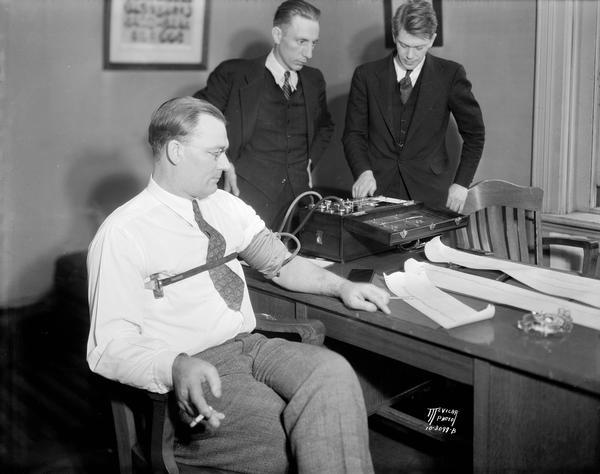
How many times have you had a student or parent or whoever tell you something that made your spidey senses tingle. How can you tell if they are lying to you. It's easier than you think to become a human lie detector.

Look for Suspicious Behaviors

By themselves, each of these behaviors can just be signs of stress, or even a person's natural mannerisms. One can occur by chance, but when two or more of these behaviors suddenly appear at a moment when lying could be expedient, you should be skeptical. For example, when you ask a salesman how reliable that used car is, it suggests he's lying.

Here's the top eight list of suspicious behaviors:

1. A change in the voice's pitch.
2. A change in the rate of speech.
3. A sudden increase in the number of "ums" and "ahs."
4. A change in eye contact. Normally, one makes eye contact one-quarter to one-half of the time. If suddenly, at the convenient moment to lie, he's staring at you or looking away, beware.
5. Turning his body away from you, even if just slightly.
6. Suddenly being able to see the white on the top and bottom of a person's eyes, not just the sides.
7. A hand reaching, even if momentarily, to cover part of the face, especially the mouth.
8. Nervous movement of feet or legs.


Of course, in order to notice a change, you need a baseline. So you must first watch the person when talking about innocuous issues.

A Mixed Signal


Also look for mixed signals. When someone's telling the truth, her words, her face and her body language are all congruent. For example, if a person is honestly saying that she likes you, her face is usually relaxed, offering a gentle smile and warm eyes. Her body is calm and open. But when she's lying, something is usually inconsistent. In the most obvious case, she may be saying she likes you, but she's not smiling. She may even have a clenched fist. Better liars can muster a smile, but it doesn't look natural. Even better liars can put on a convincing smile, but their eyes aren't smiling. Still better liars can control their entire face, but their bodies seem closed or cold. Look for mismatches between words and body language.

When you've gotten a signal -- a change in body language or a mixed signal that the person may be lying -- ask for more information about the same topic. Are those same lying signs apparent? That can confirm your suspicion.

Of course, there's no foolproof way to detect lying. Some people are terrific at covering themselves up, especially if they are naturally emotionally flat or have practiced their lying skills over many years -- certain political leaders come to mind. But if you look for behavior changes and mixed signals at lying-expedient moments, you will improve your lie detecting skills.

Tuesday, August 5, 2008

MySpace gives pastor ‘prophetic’ edge


Last Sunday, pastor Irwin Alton, 62, preached against several specific sins during his sermon. Some people in the audience gasped with recognition.

"When he talked about skipping mid-week service to go to the lake, and buying a new boat when you haven’t tithed, I felt nailed to my pew," said one man. "It was like the Holy Spirit was speaking right to me."

But it wasn’t the Holy Spirit — it was the man’s own blog where he had posted photos of himself and his buddies on his new boat on a Wednesday evening.

Pastor Alton, who cultivates a reputation as a computer illiterate techno-phobe, is actually an avid reader of MySpace pages, blogs and personal websites of the people in his congregation.

"I appear, shall we say, un-hip," he says. "Therein lies my advantage."

Though he publicly refers to the Worldwide Web as the "Worldwide Waste" and e-mail as "sin-mail," in his home office is a bank of computer screens with more than 170 bookmarked sites — personal web pages, blogs, Twitter, MySpace, Facebook, LinkedIn, Digg, Flickr and more. Each week Alton surfs the sites for hours to find evidence of questionable behavior by people in his church. He jots offenses down and incorporates them into his Sunday sermons.

He even checks the blogs of friends of people in his church. That’s where he found photos of Emily Dotson, 31, at a local sports bar. During the service last week Alton paused mid-sermon to say, "Some of you have been visiting places you shouldn’t be seen in as a Christian, drinking establishments and the like." Emily was taken aback.
"He was speaking right to me," she says.
She came forward and repented for being at the sports bar, even though she’d been celebrating a girlfriend’s birthday.

"I knew I shouldn’t have lingered in that environment," Emily says. "I could have gone in, said hi and left."

When mentioning sinful behavior Alton sometimes intentionally gets small details wrong, or remains vague.

"If I bat a thousand they might get suspicious," he says.
He never claims his messages are Holy Spirit-inspired, but many in the church believe they are.

"He’s right so often, it has to be God," says one man. "We all come to church because God is using Pastor Alton to address our particular situations. It’s phenomenal."

One family, the Bixbys, was tolerating their daughter’s college partying. Alton watched the girl’s MySpace for weeks before mentioning from the pulpit that "some parents need to get a lasso around their college-age children — and fast, before they do some real damage."

That week, the Bixbys called their daughter home to "re-establish patterns of good behavior."

"We felt that if God was merciful enough to speak prophetically through our pastor like that, we should take action," says the father.

For his part, Alton has no problem not revealing his sources.

"If they can’t make the connection between what I’m saying and what they’re putting on the Internet, then maybe God really is speaking to them," he says. "And they sure treat me with a lot more respect now."

Thursday, July 31, 2008

Thursday, July 24, 2008

An Apple Guy Remakes Microsoft


"Alex Bogusky built the country's slickest ad shop using Apple products. His next challenge: Persuade people like him to buy Microsoft's stuff."

That leading sentence to a recent article in Fast Company magazine sucked me in to the article. The story is about an unlikely firm (albeit "hot" and "hip") hired to overhaul the image problem that has plagued Microsoft for...what, about 600 years?

I don't know if Alex can do it, but I did enjoy the article, and found three great quotes in the article:

* "To try to be cool is to not be cool. To chase cool, you're chasing something that already exists, which means you're always going to be on the wrong side of it, you'll always be following."

Uh, wake-up call, how many times do we do this as church leaders?

* When asked if Alex was going to force his staff to stop using Macs in favor of Windows machines since Microsoft was now their largest client, he replied, "It's not a matter of forcing people. It's getting them to want to use it. If you can't, you're not going to do great advertising."

Rather than tell your staff or leaders that they must attend a service or have to be in a small group, how about make it so compelling that they won't stay away?

* "As the company draws bigger, more traditional clients, the risks grow proportionately. Edginess and risk taking mean nothing without results."

You can be traditional and effective. You can be edgy and ineffective. Edgy might get you on a top 100 church list somewhere, but it doesn't mean you are making disciples. Let's focus on disciple-making, and if edgy gets it done, then go for it.

According to the article, the new Microsoft ad campaign (being developed by Alex's company) is slated to break this month. Should be interesting!

Taken from www.leadingsmart.com

Thursday, July 10, 2008

Card Me.


Giving can be so simple.
STEP 1: Use as much of your card as you want.
STEP 2: Write how much is left on your card using a permanent marker.
STEP 3: Challenge your friends to join you and collect what they give.
STEP 4: Place all the cards (You & Friends) in an envelope and send it.

GiftCardGiver.com
490 East Side Ave SE
Atlanta, GA 30316

THEIR PROMISE: We have never used a card for ourselves (Not even Starbucks) and never will. Thanks for contributing and collecting.

ABOUT GiftCardGiver: How many gift cards do you have sitting in your wallet? At the very least $5? What’s 5 bucks going to buy you? Five bucks in Gift Cards may buy you a pair of socks, but 10 people giving 5 bucks will buy a kid a winter coat or 100 people giving $5 from Home Depot will give that same kid a warm bedroom to sleep through the night.

We are Gift Card Giver. We are a community, that collects and distributes unused gift cards to people and organizations in need. Did you know the Gift Card industry has risen to be a $60 billion industry. Ever wonder how many gift cards are unused? More than 10%. That’s nearly $10 Billion. Billions of dollars are waiting to be redeemed. Waiting in your pocket. Can you spare one for our friends in need?

Tuesday, July 8, 2008

Pop Goes the Church: Should the Church Engage Pop Culture?

Whether you're a regular attender, a leader, or have yet to step foot in a church, you may have questions about church that aren't being answered. How can the church remain relevant while communicating the unchanging integrity of God's truth? Author Tim Stevens makes an inspiring case for leveraging pop culture to reach out to people in the language of their lives. He offers a new perspective that gives relevance and impact to the church by using pop culture meeting people in the real world with words, sounds and images that speak to them. He encourages us to get out of our comfort zones and look people in the eyes, meeting them wherever they are, relating to their problems and society's challenges--even celebrating pop culture, where there are exciting signs of spiritual seeking. Pop Goes the Church will open your mind to church in a way that breaks down walls, engages the culture and speaks to a generation that needs to hear good news.

"In thirty years of ministry, I have never stopped believing that the local church is the hope of the world. It is my driving passion to help leaders get this, and to help them find tools to do church more effectively. Pop Goes the Church should be read by every pastor, church leader, and layperson who wants to connect people to Jesus but is finding it hard to be heard in our media-saturated culture. Some authors have suggested we should give up on the local church. Stevens, however, is making the case that a local church can be transformational in its community. He doesn't stop with theory, but gives practical how-tos and examples from churches of all sizes and styles. Pop Goes the Church is sure to become very useful for a new generation of leaders. it will compel animated conversations in conference rooms and living rooms across the world as leaders everywhere wrestle with how to leverage pop culture in and through the local church."
--BILL HYBELS, Senior Pastor, Willow Creek Community Church

"Contemporary doesn't equal revolutionary. Revolutionary change is what's needed for churches to survive and thrive. Pop Goes the Church provides a curve-jumping, revolution-starting approach to changing churches, so read it and make the world a better place."
--GUY KAWASAKI, Managing Director, Garage Technology Ventures, Author, Art of the Start

"Stevens writes with a sense of urgency that will inspire your ministry to an authentic and relevant presentation of God's transforming Word."
--STEVE GROESCHEL, Senior Pastor, LifeChurch.tv

Thursday, June 26, 2008

Cardboard Testimonies

Man…if this video doesn’t tug on the proverbial heart strings, I’m not sure what will… It’s well worth the 8 minutes of view time.

Tuesday, June 24, 2008

George Barna Interview - SHIFT '07 Conference

George Barna sits down with Bo Boshers from Willow Creek Association to talk about The Barna Group and the affect of it's research on the church today. Watch it. It's about 5 minutes long.


http://www.youtube.com/watch?v=LvaJKKKL1S8

Sunday, June 8, 2008

stole our stuff...it's cool.

Check out this video a pastor posted on youtube after their church trailer, with almost all of their church gear was stolen.


www.KineticChurch.com

Tuesday, May 20, 2008

Ask Your Mentor What You Should Be Asking Them

Brazen Careerist blogger Penelope Trunk describes her experiences in finding a mentor whose knowledge and perspective complement and augment her own—but more importantly, how she kept the relationship from dwindling. One of her key successes in maintaining a mentor came from the man himself:

The first time I asked Chris, "What should I be asking you now?" I felt silly. After all, it's a line he fed me. But now I use it with him all the time, and it's actually an invitation for him to tell me what he thinks I'm missing, which is information I wouldn't get if I directed the conversation the whole time.

Trunk also advises only contacting your mentors when you know it's easy for them to talk, and keeping them up to date on your career position. How do you successfully utilize a mentor without seeming like a time drain? Share your story in the comments.

How I got my current favorite mentor [Brazen Careerist]

Thursday, May 15, 2008

The Fred Factor


How to Turn the Ordinary Into the Extraordinary


Fred is the ordinary-looking postal carrier with a small moustache who delivers mail to motivational speaker Mark Sanborn's house in the Washington Park area of Denver. But he is no ordinary U.S. Postal Service worker. According to Sanborn, he is the kind of worker who exemplifies everything that is "right" with customer service and business in general, and is "a gold-plated example of what personalized service looks like and a role model for anyone who wants to make a difference in his or her work."

Not only did Sanborn get the best postal service he had ever experienced when he moved to Fred's route, but he also got a perfect example of superior service to illustrate his presentations to business leaders throughout the United States. According to Sanborn, anyone can be a Fred and live an extraordinary life as well.

Four Fred Principles
After examining the factors that make Fred the Postman such an extraordinarily committed service person, Sanborn honed them down to four principles that can be applied to improve anyone's life and work. These principles are:

1. Everyone makes a difference. Some might see delivering mail as monotonous drudgery, but Fred sees the task as an opportunity to make the lives of his customers more enjoyable. Regardless of whether an employer hinders exceptional performance, ignores it, or does not adequately recognize it, only the employee can choose to do his or her job in an extraordinary way. Sanborn writes, "Nobody can prevent you from choosing to be exceptional."

2. Success is built on relationships. Indifferent people deliver impersonal service. Sanborn writes that service becomes personalized when a relationship exists between the provider of the service and the customer. The quality of the relationship determines the quality of the product or service. Leaders succeed when they recognize that their employees are human, and employees like Fred the Postman succeed when they recognize their work involves interacting with other human beings.

3. You must continually create value for others, and it doesn't have to cost a penny. Replace money with imagination. Sanborn explains that the object is to outthink your competition rather than outspend them. The most critical skill that contributes to employability is the ability to create value for customers and colleagues without spending money to do it. Substitute creativity for capital. Mediocrity is your silent opponent and can diminish the quality of your performance as well as the meaning you derive from it.

4. You can reinvent yourself regularly. If Fred the Postman can excel at bringing creativity and commitment to putting mail in a box, you are probably capable of doing as much or more to reinvent your work and rejuvenate your efforts. Sanborn believes that "no matter what job you hold, what industry you work in, or where you live, every morning you wake up with a clean slate. You can make your business, as well as your life, anything you choose it to be."


Fred Sightings
Sanborn points out that Freds can be found everywhere, and there are more Freds out there than he once thought. One Fred is a woman at a hotel who helped Sanborn out in a pinch by taking his coffee-stained pants home with her overnight to personally wash and press for his departure the next day.

Another Fred he describes is a flight attendant who made a 6:15 a.m. flight from Denver to San Francisco more enjoyable for passengers by lightening the usual announcements with her unique sense of humor: "If you are having a hard time getting your ears to pop, I suggest you yawn widely. And if you are having a hard time yawning, ask me to tell you about my love life." Sanborn explains that she took some risks and had some fun, and as a result, her "customers" the passengers had fun, too.

Another Fred who Sanborn describes is a hotel worker who lent him $30 when he had no cab fare for his ride home. Sanborn explains that this Fred knows that the way to move through life joyfully and successfully is by focusing on what you give rather than what you get. Freds do the right thing because it is the right thing to do.

Sanborn explains that if you want more Freds in the world, be a Fred. Throughout the rest of The Fred Factor, he describes how every individual can make a difference, and offers numerous difference-making strategies to help readers influence the world in a positive way.

Why We Like This Book
The Fred Factor presents a compassionate look at how every action we take can be made more significant if we take the time to reinvent our work and rejuvenate our efforts. By providing a look at the normal people who do extraordinary things in their daily activities, Sanborn presents heart-warming business lessons that expose the value and endless possibilities for improving life and work that come from loving others. Copyright © 2004 Soundview Executive Book Summaries

What if Peter used TWITTER

Who hasn't heard about this Twitter thing…at first I didn’t understand it…but now I love it. It’s a great way to keep up with friends…and it definitely has both funny moments AND the ability for people to connect on the www!

So…I thought, what if this had been available during the time of Jesus and Peter would have twittered…it would have probably looked something like this…

* Just met this guy named Jesus–He changed my name, interesting…wonder what else He’s going to try and change?
* Holy smoke…just landed a HUGE catch of fish by doing what this Rabbi said.
* Just left the family business to follow Jesus–this guy captivates me.
* Today Jesus fed over 5,000 men with a kids happy meal…and even multiplied the surprise!
* Walked on water today for a little while–Thomas doubted whether or not I could and Judas was giving four to one odds on me drowning.
* YEAH…I got it right! Jesus is the Messiah…He encouraged me.
* Jesus just called me satan…I am thinking I got something wrong.
* Trying to sleep…I think Jesus is praying over there…
* Just cut a guys ear off, Jesus fixed it–no problem.
* I think it’s over–He’s dead.
* I think we’re next!
* I think somethings happening…He’s not in the tomb.
* He’s alive–he just walked through a flippin’ wall!
* It’s ON–He just did that fish catching thing again!
* He just said something about having all authority–after what I just saw…I believe it!
* Just preached my first public sermon, 3,000 people received Christ…was waterlogged after the baptism service.
* Two people lied about the offering today - God killed them for it - giving increase 462% afterwards.

Well, Peter didn’t Twitter…but we do get to read about him in Matthew, Mark, Luke & John and his journey with Jesus.

What IF they would have had the technology we have? Another post sometime…

Thursday, May 1, 2008

How to Be a Better Listener in 3 Easy Steps


Going All the Way by Craig Groeschel of LifeChurch.tv (Edmond, OK) was written as a guide to having a better marriage, but it also has some valuable lessons for leaders. In particular, Craig discusses how to be a better listener in 3 easy steps.

1. When someone is speaking, stop everything and focus intently on the other person.
Don’t think about something else. Don’t formulate your response. You’re goal is to comprehend not just the person’s words, but their heart.

2. Don’t just listen with your ears, but also with your eyes.
Pay attention to facial expressions and to body language. You’ll be surprised how much information comes through gestures and stance, even how the other person breathes while they’re talking.

3. Repeat back to the person what you’re hearing so the other person knows what you heard.
By telling [someone] what I think [he] meant, I can confirm that I’ve understood [him]. It also affirms to [him] the value of what [he] said. It shows [him] not just that I heard [him], but that I was listening. Which demonstrates to [him] that I care.


Being a good listener not only makes you more likable but wiser. There is a lot to be learned from the ideas and insights of other people.

Tuesday, April 22, 2008

The "pray if you feel led" prayer

This, can be a surprisingly tense moment. At church or in a small group, someone will say, "I'll open us in prayer, Lisa you close us, and everyone else pray if you feel led."

Suddenly, there's an expectation. In less than a minute that opening prayer is going to be finished and you'll be faced with an incredibly difficult decision. Do I pray? Do I feel led? When do I pray? When is the "Closer" going to speak up and put an end to this prayer? How do I not start praying at the same time as someone else? So many questions, each fraught with danger and intrigue. That's why I have created the simple, "6 people you meet in a prayer circle." It's like that book, "5 people you meet in heaven," but slightly more sarcastic and bound to sell slightly fewer copies. Actually it will sell none, because here it is:

6 people you meet in a prayer circle:

1. The Almost-er
This is the person sitting near you that is constantly on the verge of praying. You can hear them doing that little breath thing, that little exhale before you are about to speak. And you can hear it because it's loud in the deafening silence of the prayer circle. Every time you are about to say a prayer you hear the Almost-er and you stop out of courtesy. And then they don't pray. So you start again and a long exhale from the Almost-er stops you again. It's quite a little dance.

2. The Gun Slinger
When there are only two people left that have not prayed and the Closer is mentally warming up to end the session, you may find yourself in a prayer showdown. It's just you and another girl that looks like a heathen right now for not praying. The entire circle senses that the prayers were good but they need one more before the Closer prays. They need one more tiny prayer to kind of wrap things up. But you don't want to pray and neither does the Gun Slinger. So you sit their in silence across from each other like cowboys in the street, waiting, letting the tension and the awkwardness build until finally someone draws their gun and blurts out, "Lord thank you for this day and everything you blessed us with!"

3. The Opener
You might think the "Closer" is the one with all the power, but don't be misled, the opener is in control. In addition to often choosing the Closer, they set the tone for the entire prayer circle. If they go long, people after them are going to go long. If they work in cute little jokes to the opening prayer, the people after them are more likely to be casual too. More than that, they don't need to worry about the Closer or fear someone cutting them off. They can pray and then relax. Their job is over and done in a matter of seconds.

4. The Rambler
Another name for this person is the "Jon Acuff." This is the guy or gal that sees the chance to pray in front of people as an open microphone. A chance to not so subtly reference everything they've recently learned during their quiet time in one long, rambling prayer. And there's no way to stop them, unless you are married to them. If you are, then like my wife, you can grab his hand and give him a squeeze that says, "I love you, you are good at praying but no one wants to hear about the spiritual mysteries you have uncovered recently in the book of Joel."

5. The Cave In
Deciding not to pray in a prayer circle is like not giving to a love offering. What you don't have any love in your heart? What you don't feel led? You're the only person in the room that didn't get led? Maybe we should pray for you instead of doing this prayer circle. Expect at least one person to be the Cave In.

6. The Closer
Closing a prayer circle is like being Spiderman. It's a gift and a responsibility. Although you get to determine when it ends, you also have to monitor the amount of quiet time that signifies everyone has gone. Because what you don't want to happen, what the Closer fears the most is the "Encore-ist." This is the person that goes after the Closer, boldly defying all rules of group prayer. It's an embarrassing situation for a Closer and for a few minutes afterward it's hard to make eye contact with them.

Bonus - 7. The Shot Blocker
This one is rare. Hearing this one in a group prayer is like seeing a unicorn. On the highway. With Gary Coleman riding it's back in the breakdown lane. In basketball, when someone on the opposing team swats your shot with their hand, preventing you from scoring, this is called "shot blocking." The same thing can happen in a prayer circle. It usually looks like this:

Person 1: "Lord, thank you for affirming my decision to take a new job."

Shot blocker:
"Lord please give Danielle more patience and discernment as she looks for a new job. Help her not rush into anything."


This is the basketball equivalent of someone blocking your shot into another state. Just as you try to send up a prayer to God, they swoop in and contradict you. (Thanks LunarWorld for the idea.)

Those are the six people I find most common in prayer circles, but I bet you've run into some others in your day.

Taken from www.stuffchristianslike.net

Gratitude

by Craig Groeschel

Jesus told a story about ten lepers who were healed. Only one returned to say “thank you.” I hope I am always the one.

We are where we are because of people God has put in our lives.

I challenge you to make a list of ten people who have influenced you and write them each a personal note of gratitude.

Your list might include:
Your mom or dad.
Your grandparents.
Your fifth grade teacher, your eighth grade coach, or your preaching professor from seminary.
Your youth pastor from childhood, the speaker who came to your youth camp, or the volunteer leader who listened to you when you were hurting.
Your friend who prayed for you daily.
The author of some book that touched your life in a deep way.
Some pastor you’ve never met but feeds you spiritually weekly on your iPod.
Some person who said one thing that encouraged you when you needed it.


Who are a few of the people for whom you’re grateful? When are you going to write that letter you’ve been putting off?

Tuesday, March 4, 2008

you're part of my somebody.

Oscar-Nominated Actress Ruby Dee reciting a poem. The heart of someone who cares. Watch it.

Thursday, February 21, 2008

Four Qualities Of An Awesome Team Member

Taken from www.PerryNoble.com

#1 - An Awesome Team Member ALWAYS Tells The Truth.


I have a rule with the leadership team that I serve with.  Here’s the rule…

When we sit in our staff meetings I want nothing but the raw, honest, painful truth about ANYTHING that we happen to be discussing/working through.

I am not one of those guys who allows only certain things to be said to me on certain days…I want honesty from those closest to me.

Let me say this…as a leader YOU must make sure to do all that you can to create this type of environment. You MUST invite conflict. For example, I’ve seen people give looks of disapproval when people make a comment but not speak up…and so I will say, “Hey Jason, it seems you didn’t agree with what Tony just said–what are you thinking?”

YES…it does create tension…but this is how the best decisions are made.

The same is true in our creative team…if I share an idea and it is not good–I want to know! AND…if I perceive that someone isn’t being truthful with me…I want them off of the team! Life is too short to surround myself with people who blow smoke up my rear end…I want the truth!

(By the way…this was not my idea…it comes from every successful leader I’ve ever seen.)

#2 - An Awesome Team Member ALWAYS Respects Everyone Else On The Team.

I am HUGE when it comes to respect. I am convinced that THE only reason that I am where I am in life is because of the favor and blessing of God, NEITHER of which I deserve…and so when it comes to our environment I do not want it to be a “respect Perry only” place…but EVERYONE respects EVERYONE.

Let me be VERY clear here…I respect EVERYONE on the team I serve with…and if I didn’t respect them then they would not be in the room leading with me. I LOVE these people…and when they speak…I LISTEN. God has used them to fire me up, inspire me, teach me AND humble me…and ANYONE of them can come to me at any time and share with me what is on their hearts because I respect them.

BUT…they also share that same respect with one another–which is ESSENTIAL for a successful team. If there is disrespect among the team members then you team will always drift towards dysfunction.

#3 - An Awesome Staff Member Is Always Loyal.

One of the things our team knows and understands is this–we all have each other’s backs!

Now let me be VERY clear…we would NEVER conceal any type of sin and disguise it as “being loyal.” That, to me, is overriding a Biblical mandate with a desire for comfort.

BUT…when someone else comes up to one of us and tries to talk smack about someone else on the team–we don’t put up with that–EVER.

Trust is ESSENTIAL for a team to achieve its maximum potential. You can’t sit around a table with people who you believe are going to go out of the room and bash you to their friends and co-workers. If I didn’t perceive that someone on the team was loyal to the entire team…they would be gone.

Behind closed doors anyone is free to say anything to anyone…but when we walk out of that room we do so with one vision…and we won’t allow people to take our eyes off of it.

#4 -An Awesome Team Member Never Seeks To Do The Minimum.

If you have someone on the team who is constantly trying to get out of work (OR who wants a divine marching band to play for him/her every time they seemingly go above and beyond)–WATCH OUT!

One of the incredible things about the team I serve with is that I KNOW that NO ONE that sits around the table has EVERY thought, “How can I do as little as possible and still seem to be getting my job done?’

I serve with people who have a pit bull type of intensity. When we come up with a project and assign it to whoever…they don’t halfway do it and then throw out excuses…they MAKE things happen…and are committed to doing whatever it takes to make sure that God’s work is done with EXCELLENCE.

Jesus Christ did not change the world with half-hearted, lazy, self seeking people whose biggest desire was to be solitaire on their computer! He turned the world upside down with men and women who were willing to go wherever and do whatever He asked of them…and He’s still seeking the same type of people today.

Hope that helps…

Thursday, February 7, 2008

The Choice-Minimal Lifestyle: 6 Formulas for More Output and Less Overwhelm

TAKEN FROM www.fourhourworkweek.com (THE BLOG OF TIM FERRISS)

I was stressed out… over dog cartoons.

It was 9:47pm at Barnes and Noble on a recent Saturday night, and I had 13 minutes to find a suitable exchange for “The New Yorker Dog Cartoons,” $22 of expensive paper. Bestsellers? Staff recommends? New arrivals or classics? I’d already been there 30 minutes.

Beginning to feel overwhelmed with a ridiculous errand I’d expected to take five minutes, I stumbled across the psychology section. One tome jumped out at me as all too appropriate—The Paradox of Choice: Why More is Less. It wasn’t the first time I’d seen or read Barry Schwarz’s 2004 classic, but it seemed like a good time to revisit the principles, among them that:

-The more options you consider, the more buyer’s regret you’ll have.
-The more options you encounter, the less fulfilling your ultimate outcome will be.

This raises an difficult question: Is it better to have the best outcome but be less satisfied, or have an acceptable outcome and be satisfied?

For example, would you rather deliberate for months and get the 1 of 20 houses that’s the best investment but second-guess yourself until you sell it 5 years later; or would you rather get a house that is 80% of the investment potential of the former (still to be sold at a profit) but never second-guess it?

Tough call.

One call wasn’t tough: he recommends making non-returnable purchases. I decided to keep the stupid pooch cartoons. Why? Because it’s not just about being satisfied, it’s about being practical.

Income is renewable, but some other resources—like attention—are not. I’ve talked before about attention as a currency and how it determines the value of time.

The Art of Letting Bad Things Happen explores this using case studies, but here’s one example to illustrate: is your weekend really “free” if you find a crisis in the inbox Saturday morning that you can’t address until Monday morning?

Even if the inbox scan lasts 30 seconds, the preoccupation and forward projection for the subsequent 48 hours effectively deletes that experience from your life. You had time but you didn’t have attention, so the time had no practical value.

The choice-minimal lifestyle becomes an attractive tool when we consider two truths:

1) Considering options costs attention that then can’t be spent on action or present-state awareness.

2) Attention is necessary for not only productivity but appreciation.


Therefore:

Too many choices = less or no productivity
Too many choices = less or no appreciation
Too many choices = sense of overwhelm

Some people find that religion enables a practical choice-minimal lifestyle, as tenets often limit the number of possible actions. During his year of attempting to follow the rules of the Bible literally, the then-agnostic AJ Jacobs of Esquire cited the rules and restrictions of the Bible as amazing in this respect. Not having to consider a wide spectrum of options or actions—as he was following immutable if-then rules—allowed him to focus undiluted attention on the areas that weren’t constrained. The result? Increased output.

Even though I attended an Episcopal high school, I’m not religious in the common sense (and I don’t use the term “spiritual”), so this approach isn’t mine.

What to do? There are 6 basic rules or formulas that can be used, regardless of denomination.

1. Set rules for yourself so you can automate as much decision-making as possible (see the rules I use to outsource my e-mail to Canada as an example of this)


2. Don’t provoke deliberation before you can take action.


One simple example: don’t scan the inbox on Friday evening or over the weekend if you might encounter work problems that can’t be addressed until Monday.

3. Don’t postpone decisions or open “loops,” to use GTD parlance, just to avoid uncomfortable conversations.

If an acquaintance asks you if you want to come to their house for dinner next week, and you know you won’t, don’t say “I’m not sure. I’ll let you know next week.” Instead, use something soft but conclusive like “Next week? I’m pretty sure I have another commitment on Thursday, but thank you for the invite. Just so I don’t leave you hanging, let’s assume I can’t make it, but can I let you know if that changes?” Decision made. Move on.

4. Learn to make non-fatal or reversible decisions as quickly as possible.

Set time limits (I won’t consider options for more than 20 minutes), option limits (I’ll consider no more than 3 options), or finance thresholds (Example: If it costs less than $100 [or the potential damage is less than $100], I’ll let a virtual assistant make the judgment call or consider no more than 3 options).

I wrote most of this post after landing at the monster that is ATL airport in Atlanta. I could have considered half a dozen types of ground transportation in 15 minutes and saved 30-40%, but I grabbed a taxi instead. To use illustrative numbers: I didn’t want to sacrifice 10 attention units of my remaining 50 of 100 total potential units, since those 10 units couldn’t then be spent on this article. I had about 8 hours before bedtime due to time zone differences—plenty of time—but scarce usable attention after an all-nighter of fun and the cross-country flight. Fast decisions preserve usable attention for what matters.

5. Don’t strive for variation—and thus increase option consideration—when it’s not needed. Routine enables innovation where it’s most valuable.

In working with athletes, for example, it’s clear that those who maintain the lowest bodyfat percentage eat the same foods over and over with little variation. I’ve eaten the same “slow carb” breakfast and lunch for nearly two years, putting variation only into meals that I focus on for enjoyment: dinner and all meals on Saturdays. This same routine-variation distinction can be found in exercise vs. recreation. For fat-loss and muscle gain (even as much as 34 lbs. in four weeks), I’ve followed the same time-minimal exercise protocol with occasional experiments since 1996. For recreation, however, where the focus is enjoyment and not efficacy, I tend to try something new each weekend, whether climbing at Mission Cliffs in SF or mountain biking from tasting to tasting in Napa.

Don’t confuse what should be results-driven with routine (e.g. exercise) with something enjoyment-driven that benefits from variation (e.g. recreation).

6. Regret is past-tense decision making. Eliminate complaining to minimize regret.

Condition yourself to notice complaints and stop making them with a simple program like the 21-day no-complaint experiment. Just a bracelet and awareness can prevent wasted past-tense deliberation that improves nothing and depletes your attention and emotional reserves.

###

Decision-making isn’t to be avoided—that’s not the problem. Look at a good CEO or top corporate performer and you’ll see a high volume of decisions.

It’s deliberation—the time we vacillate over and consider each decision—that’s the attention consumer. Total deliberation time, not the number of decisions, it was determines your attention bank account balance (or debt).

Let’s assume you pay 10% over time by following the above rules but cut your average “decision cycle” time by an average of 40% (10 minutes reduced to 6 minutes, for example). No only will you have much more time and attention to spend on revenue-generating activities, but you’ll get greater enjoyment from what you have and experience. Consider that 10% of additional cost as an investment and part of your “ideal lifestyle tax,” but not as a loss.

Embrace the choice-minimal lifestyle. It’s a subtle and underexploited philosophical tool that produces dramatic increases in both output and satisfaction, all with less overwhelm.

Make testing a few of the principles the first of many fast and reversible decisions.

Sunday, February 3, 2008

An Incomplete Manifesto for Growth

An Incomplete Manifesto for Growth
Author: Bruce Mau (1998)


1. Allow events to change you. You have to be willing to grow. Growth is different from something that happens to you. You produce it. You live it. The prerequisites for growth: the openness to experience events and the willingness to be changed by them.

2. Forget about good. Good is a known quantity. Good is what we all agree on. Growth is not necessarily good. Growth is an exploration of unlit recesses that may or may not yield to our research. As long as you stick to good you’ll never have real growth.

3. Process is more important than outcome. When the outcome drives the process we will only ever go to where we’ve already been. If process drives outcome we may not know where we’re going, but we will know we want to be there.

4. Love your experiments (as you would an ugly child). Joy is the engine of growth. Exploit the liberty in casting your work as beautiful experiments, iterations, attempts, trials, and errors. Take the long view and allow yourself the fun of failure every day.

5. Go deep. The deeper you go the more likely you will discover something of value.

6. Capture accidents. The wrong answer is the right answer in search of a different question. Collect wrong answers as part of the process. Ask different questions.

7. Study. A studio is a place of study. Use the necessity of production as an excuse to study. Everyone will benefit.

8. Drift. Allow yourself to wander aimlessly. Explore adjacencies. Lack judgment. Postpone criticism.

9. Begin anywhere. John Cage tells us that not knowing where to begin is a common form of paralysis. His advice: begin anywhere.

10. Everyone is a leader. Growth happens. Whenever it does, allow it to emerge. Learn to follow when it makes sense. Let anyone lead.

11. Harvest ideas. Edit applications. Ideas need a dynamic, fluid, generous environment to sustain life. Applications, on the other hand, benefit from critical rigor. Produce a high ratio of ideas to applications.

12. Keep moving. The market and its operations have a tendency to reinforce success. Resist it. Allow failure and migration to be part of your practice.

13. Slow down. Desynchronize from standard time frames and surprising opportunities may present themselves.

14. Don’t be cool. Cool is conservative fear dressed in black. Free yourself from limits of this sort.

15. Ask stupid questions. Growth is fueled by desire and innocence. Assess the answer, not the question. Imagine learning throughout your life at the rate of an infant.

16. Collaborate. The space between people working together is filled with conflict, friction, strife, exhilaration, delight, and vast creative potential.

17. ——————————. Intentionally left blank. Allow space for the ideas you haven’t had yet, and for the ideas of others.

18. Stay up late. Strange things happen when you’ve gone too far, been up too long, worked too hard, and you’re separated from the rest of the world.

19. Work the metaphor. Every object has the capacity to stand for something other than what is apparent. Work on what it stands for.

20. Be careful to take risks. Time is genetic. Today is the child of yesterday and the parent of tomorrow. The work you produce today will create your future.

21. Repeat yourself. If you like it, do it again. If you don’t like it, do it again.

22. Make your own tools. Hybridize your tools in order to build unique things. Even simple tools that are your own can yield entirely new avenues of exploration. Remember, tools amplify our capacities, so even a small tool can make a big difference.

23. Stand on someone’s shoulders. You can travel farther carried on the accomplishments of those who came before you. And the view is so much better.

24. Avoid software. The problem with software is that everyone has it.

25. Don’t clean your desk. You might find something in the morning that you can’t see tonight.

26. Don’t enter awards competitions. Just don’t. It’s not good for you.

27. Read only left-hand pages. Marshall McLuhan did this. By decreasing the amount of information, we leave room for what he called our “noodle.”

28. Make new words. Expand the lexicon. The new conditions demand a new way of thinking. The thinking demands new forms of expression. The expression generates new conditions.

29. Think with your mind. Forget technology. Creativity is not device-dependent.

30. Organization = Liberty. Real innovation in design, or any other field, happens in context. That context is usually some form of cooperatively managed enterprise. Frank Gehry, for instance, is only able to realize Bilbao because his studio can deliver it on budget. The myth of a split between “creatives” and “suits” is what Leonard Cohen calls a 'charming artifact of the past.'

31. Don’t borrow money. Once again, Frank Gehry’s advice. By maintaining financial control, we maintain creative control. It’s not exactly rocket science, but it’s surprising how hard it is to maintain this discipline, and how many have failed.

32. Listen carefully. Every collaborator who enters our orbit brings with him or her a world more strange and complex than any we could ever hope to imagine. By listening to the details and the subtlety of their needs, desires, or ambitions, we fold their world onto our own. Neither party will ever be the same.

33. Take field trips. The bandwidth of the world is greater than that of your TV set, or the Internet, or even a totally immersive, interactive, dynamically rendered, object-oriented, real-time, computer graphic–simulated environment.

34. Make mistakes faster. This isn’t my idea — I borrowed it. I think it belongs to Andy Grove.

35. Imitate. Don’t be shy about it. Try to get as close as you can. You’ll never get all the way, and the separation might be truly remarkable. We have only to look to Richard Hamilton and his version of Marcel Duchamp’s large glass to see how rich, discredited, and underused imitation is as a technique.

36. Scat. When you forget the words, do what Ella did: make up something else … but not words.

37. Break it, stretch it, bend it, crush it, crack it, fold it.

38. Explore the other edge. Great liberty exists when we avoid trying to run with the technological pack. We can’t find the leading edge because it’s trampled underfoot. Try using old-tech equipment made obsolete by an economic cycle but still rich with potential.

39. Coffee breaks, cab rides, green rooms. Real growth often happens outside of where we intend it to, in the interstitial spaces — what Dr. Seuss calls “the waiting place.” Hans Ulrich Obrist once organized a science and art conference with all of the infrastructure of a conference — the parties, chats, lunches, airport arrivals — but with no actual conference. Apparently it was hugely successful and spawned many ongoing collaborations.

40. Avoid fields. Jump fences. Disciplinary boundaries and regulatory regimes are attempts to control the wilding of creative life. They are often understandable efforts to order what are manifold, complex, evolutionary processes. Our job is to jump the fences and cross the fields.

41. Laugh. People visiting the studio often comment on how much we laugh. Since I’ve become aware of this, I use it as a barometer of how comfortably we are expressing ourselves.

42. Remember. Growth is only possible as a product of history. Without memory, innovation is merely novelty. History gives growth a direction. But a memory is never perfect. Every memory is a degraded or composite image of a previous moment or event. That’s what makes us aware of its quality as a past and not a present. It means that every memory is new, a partial construct different from its source, and, as such, a potential for growth itself.

43. Power to the people. Play can only happen when people feel they have control over their lives. We can’t be free agents if we’re not free.

Provided by www.BrandAutopsy.com

Tuesday, January 22, 2008

Confessions of a Reformission Rev.


Last September I had the privilege of meeting Mark Driscoll, lead pastor of Mars Hill Church in Seattle, Washington. (They have a podcast–I would highly recommend it!) It was an awesome experience to meet with this guy for two reasons…#1, he is the real deal, what you see (and hear) is what you get–he’s not a “Christian all-star celebrity”…and #2, I had been listening to his messages on-line for so long–it was cool to discover that this dude really did exist.

Mark has written a couple of books–but the one I want to talk about is his latest one, “Confessions of a Reformission Rev.” I know I say this a lot–but if you are a pastor–or you love and care for one–you have GOT TO READ THIS BOOK!!! (Here is the link if you want to order it!)

If you have ever listened to Mark preach then you know he is honest and straightforward. This guys main concern is not making sure people are happy and church politics–he preaches from the Bible and all he talks about is Jesus–which is an awesome thing.

Mark is VERY transparent in this book about his struggles as a pastor. Let me say this–if you are considering going into the ministry…READ THIS BOOK! Mark tells you some things that seminary will not teach you. He speaks of the sexual temptation, burnout, struggles in his marriage, satanic attacks–I am serious folks–it is intense!!!

(Let me just say that I agree with Jonathan that one of the best parts of the book is when he talks about a time when he had “the runs” and decided to preach anyway…and then 15 minutes into his message he crapped his pants! I won’t tell you the rest–you’ve got to read it for yourself–and you will laugh out loud!!!)

I have serious ADD…and so I made the decision about a year ago that if a book did not captivate my attention in the first three chapters that I was not going to read it. Mark definitely had my attention…and he kept it throughout the book. It is an easy read–but please don’t take that as meaning it is not challenging. I have plans on reading it again and possibly taking my lead team through it together.

People always ask me when they read a book that I recommend, “Did you agree with everything in the book?” The answer is always no; however, in this book the issues that I disagree with Mark on are merely a personal preference or two…and I will not elaborate any further. One of the problems with Christians today I feel is that we claim to love Jesus…but we will get mad at people when they don’t think and act exactly like us! Mark is in love with Jesus and is reaching people in Seattle–which by defalt means that he gets to drink Starbucks coffee–which makes me very jealous!!!

Let me share two of my favorite quotes with you from the book…

#1 - In regards to what he discovered when visiting other churches…and the disappointment he faced…

“The woman pastor of this church, wearing a very nice, flowing, cutting-edge-of-the-1536 robe, talked about rainbows for twenty minutes while sixty or so very old people who were former classmates of Noah and eyewitnesses to the covenant rainbow sat scattered among one thousand seats or so and napped in Jesus’ name. Between her sermonette, the written literature I picked up told me how to bequeath my estate to the church when I die, and looking around the room at the equilevent of a Viagra before-photo of lifeless geriatrics. I truly could not discern why that church existed. The closest I came to finding someone with a mission was the children’s pastor, namely the meek husband of the senior pastor in pumps, who said his goal was to make his wife happy, which made me very sad.”

#2 - In regards to challenging men to become men!!!

“Things were starting to get out of hand with the men, so I called a meeting and demanded that all of the men in our church attend. I preached for more than two hours about manhood and basically gave the dad talk to my men for looking at porno, sleeping with young women, not serving Christ, not working hard at their jobs, and so on. I demanded that the men who were with me on our mission to change the city stay and that the rest leave the church and stop getting in the way because you can’t charge hell with your pants around your ankles, a bottle of lotion in one hand, and a Kleenex in the other.”

I could list more…but you’ve got to read it for yourself–excellent read!

Review taken from PerryNoble.com
 

Thursday, January 17, 2008

Going All the Way by Craig Groeschel


Going All the Way by Craig Groeschel of LifeChurch.tv (Edmond, OK) is a relationships book that discusses how to prepare for a marriage that goes the distance. While most books in this genre are written only for married couples or only for the engaged or the dating or even just for singles, Craig does a great job presenting Biblical advice that can help people regardless of what their relationship status is.

He covers topics such as putting God first, finding your soul mate, dating tips, purity tips, godly relationships, and even how and when to break up. He explains how to be a good husband and how to be a good wife. And he discusses what it takes to keep one’s marriage passionate and one’s priorities in line. In other words, Going All the Way will give you a balanced education of everything it takes to have a successful marriage.

A few highlights:
Minor adjustments produce marginal results. To experience the kind of relationships we long for, we must, with God’s help, prepare to be genuinely different.

Loving the Lord is our first priority. Without Jesus in first place, what comes next will never quite work, including our love relationships.

If you want what few have, do what few do. Raise your standards. Pursue holiness.

“Husbands, love your wives, just as Christ loved the church and gave himself up for her” (Ephesians 5:25). Men, when you become a husband, it’ll be an honor to give yourself up for your wife.

Everyone has seasons when an important lower priority takes a disproportionate amount of time. Those are seasons anyone can endure… if they don’t become a way of life.

Keep the good things from taking priority over the best.

What person do I need to become so I’ll be ready for a healthy, fulfilling marriage… and bless my spouse-to-be?
[Develop] both a thick skin and a soft heart.

Marriages are healthy because the couple learns to face and work through problems.


Going All the Way is a worthwhile investment.

Tuesday, January 8, 2008

Five “Gut Check” Questions

Taken from PerryNoble.com
Senior Pastor of New Spring Church in South Carolina


From time to time…in any arena of life there is a time for a “gut check.” We all experience it–but I think this is especially true in ministry. Here are five questions I often use to do a personal gut check…

#1 - Am I Listening To The Voice of God?

I had lunch with a pastor once who was curious about the success of New Spring Church. During the course of our time together he asked me, “How do you make the really important decisions around here?” I told him, “I just try really hard to hear the voice of God.”

He looked at me with an extremely confused look on his face and so I continued, “I think one of the most important things a person can do is spend daily time with the Lord and seek His voice.” He then gave me a “isn’t that sweet” sort of look and we moved on.

I said it this past year at Unleash–Leadership is as easy as listening to God…and my job as a leader is to listen to and obey His voice–not some committee of really frustrated men who never seek the face of the Lord but feel they are somehow qualified to lead His church.

Scripture says in Isaiah 2:22 that we are not to fear man, but the Lord. Pastor–what is it that the Lord is telling you to do that scares you to death because you know “they” will not approve? Listen to the voice of God because…He is Sovereign…they are not!

#2 - Am I Taking Risks?

The thing I never want to do here at NewSpring is begin to play it safe. Starting this church was a risk, moving to the Fine Arts Center was a risk. Moving to this facility was a risk. AND…the next steps the Lord is leading us to take is a risk.

I never want to be one of those leaders who merely say, “Well, you know, I am praying about it!” Christians often use prayer as an excuse for inactivity…but because it sounds spiritual then no one can argue.

I laugh when I read I Samuel 17, the story of David and Goliath. In reading that story it is clear in I Samuel 17:16 that the Israelites were held in bondage for 40 days by the giant. I am sure they prayed for God to remove the giant…maybe they sang songs to God about what a giant killer He was…or better yet, they began Bible studies on how to kill a giant. BUT–it wasn’t until David walked down into the valley and cut off his flippin’ head that people were set free.

David took a risk. What is the risk that God wants you to take–but you refuse?

#3 - Am I Understanding How Big God Is?

On my journey through Scripture I am understanding more and more how HUGE God is…and how much more He desires to do.

One of the problems with the modern church is that we limit God. I remember once after a service here at NewSpring where 50 people gave their lives to Christ a young lady went to have lunch with her family and told them all about the service. Her grandmother actually said, “That’s not of God–I’ve been in church all my life and have NEVER seen anything like that–those things just don’t happen!”

WHAT?

Why does the church limit God when Jesus said what He said in John 14:12? Why can’t God grow a church like He did in the book of Acts? Why can’t entire communities be transformed? Why can’t we see things happen in our time that happened in Scripture? Is He not the same God?

God is so much bigger than your greatest fear or obstacle!

#4 - Am I Surrounding Myself With The Right People?

One of the privileges I have here at NewSpring is working with an unbelievable staff. As I have said before–we are not the most “professionally trained” people on the planet; in fact, we have one person with a seminary degree on the entire staff. All we have is a bunch of common men and women who are in love with Jesus and also love seeing people meet Jesus! (Sort of like Acts 4:13)

AND–everyone here believes that God CAN DO AWESOME THINGS. When I recently shared with our staff that I feel NewSpring will one day have over 100,000 people attending every weekend through our multi-site venues–our staff nearly went through the roof!!! We believe God for awesome things!!!

Oh yeah…one more benefit of not hiring the “professionally trained” is that, because they are from the market place–they KNOW how to connect with those who are disconnected from Christ.
AND also–no one here has their own agenda…they are sold out to the vision of this church. Folks–you either have vision or division…and God works through one and not the other!!!

#5 - Am I Giving It My Best?

I was reminded the other day when reading Ecclesiastes 9:10 that I am called by God to give my 100% absolute best in all that I do.

One of the temptations of ANY pastor of a growing ministry is to slip into cruise control and “take it easy.” AND maybe that works for some people; however, I just can’t. God hasn’t called me to go at 50%…nor has He called me to pursue a ministry with a “that’s good enough” philosophy. I figure if God gave His very best for me by sending Jesus to the cross…I am called to offer my best back to Him.

(If you REALLY want to see how God feels about leftovers–check out Malachi 1:6-14!)

As a husband, father and leader I am to give it my best in all that I do. That doesn’t mean that I am perfect…heck, I am FAR from that, but…it does mean that all that God has called me to do that I should embrace and do with all my heart…knowing that He will make up the difference!